
For anyone who enjoys baking or cooking with whole wheat flour, having a supply of wheat berries on hand can be a great convenience. Wheat berries are the whole, unprocessed kernels of wheat, and they can be stored for long periods of time without losing their freshness.
Plus, they’re high in vitamins and minerals (like calcium, fiber, and other nutrients) that make them great for just about all kinds of recipes.
Here are some tips to help you do it right!
What Exactly Are Wheat Berries?
Wheat berries are the whole kernels of wheat that can be ground into flour or used as a cooked grain. They are an excellent source of fiber and other nutrients, and they have a chewy texture and nutty flavor.
Wheat berries are often used in baking and cooking. Because they are a whole grain, they contain all of the nutrients that are found in wheat, including fiber, protein, and minerals.
Wheat berries can be found in natural food stores, but they can also be grown at home.
Homegrown wheat berries will likely be fresher and more flavorful than those found in stores, and they can be a fun and satisfying project for the avid gardener.
To grow wheatberries, simply plant wheat seeds in rich, well-drained soil in early spring. Give the plants plenty of room to grow, as they will produce long stalks of grain. Harvest the wheatberries when the grain is ripe (usually in late summer or early fall), then thresh and clean the grain before using.
With a little effort, you can enjoy delicious wheat berries straight from your own garden! And then all that’s left is figuring out how to preserve your wheat berries for long-term food storage.
Let’s take a closer look.
What is the Shelf Life of Wheat Berries?
Wheat berries have a storage life of up to 30 years if they are properly stored. The key to storing wheat berries is to keep them dry and protected from insects. They can be stored in an airtight container in a cool, dry place. When ready to use, wheat berries can be cooked like rice or used in salads, soups, or casseroles.
Obviously, they can also be used for baking your favorite breads, too!
How to Keep Wheat Berries for Long-Term Storage
If you’re planning on storing wheat berries, there are a few other tips you should keep in mind.
In the Freezer
You can store wheat berries in the freezer. To do so, spread the wheat berries in a single layer on a baking sheet and place them in the freezer for one to two hours, or until they are frozen solid. Then, transfer the wheat berries to a freezer-safe container and label it with the date.
Wheat berries will keep in the freezer for up to six months. When you’re ready to use them, simply thaw the wheat berries at room temperature or cook them while they are still frozen.
Store Wheat Berries in Buckets
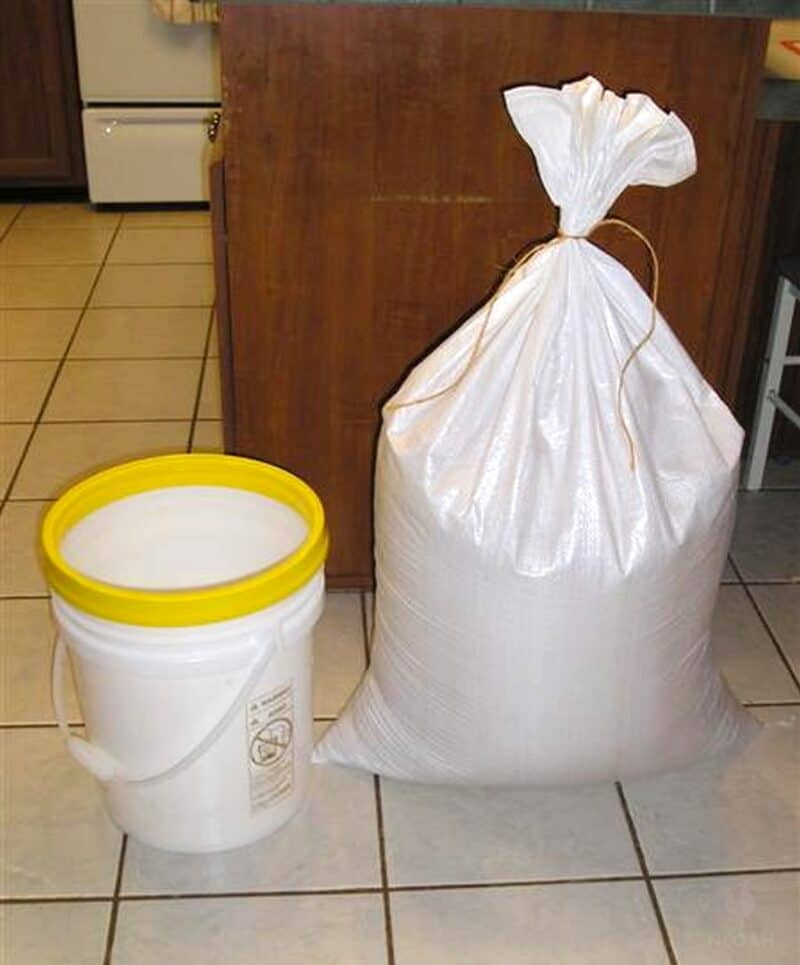
Here is one of the 100 lb. sacks of wheat from the mill, and one of the buckets we are using to store the wheat in. We got our buckets from the bakery at the grocery store.
Almost every day my husband would go to the bakery and ask them if they had any empty icing buckets. Sometimes they would not have any, sometimes they would, and sometimes they’d try to sell them to us!
The stores in our neck of the woods sell them for like $3 each, probably ’cause so many people around here ask for them. But a short drive into town usually scored us some free buckets. We’d take any size, but the 5 and 6-gallon buckets are what we really want.
At times we’d get some buckets with no lids, which is a bummer ’cause you kinda need lids, but we’d take them anyways.
When looking for a bucket to store your grains in, you need to make sure that you use a food grade plastic bucket. You can’t just run to Home Depot and buy buckets.
On the bottom of a food grade bucket will be an HDPE, with a number two within a triangle of arrows. I’ve read that the colored buckets, even if they have the #2 on them, are not safe. If you wanna be safe, get white buckets.
We also bought Gamma Seal lids to go with our buckets… for two reasons. The first was that we didn’t have lids for all of the 6 gallon buckets, and needed some. The second was that the Gamma Seals are excellent for food storage, as they are airtight and leak proof. Plus, they screw on and off super easy.
And the best part about them, in my opinion, is that they are probably the only thing in my home that is actually made in the USA! Imagine that. They are a bit pricey (like $7 each!), but I figure if we’re gonna be storing food long term we’d better do it right.
For those of you who have never seen wheat berries, let me open my sack of wheat to give you a peak:
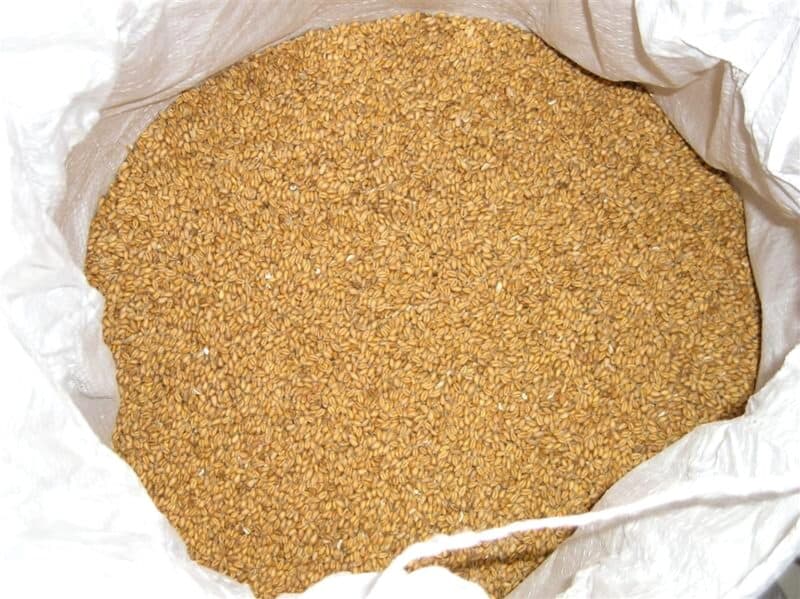
Go ahead, look a little closer…
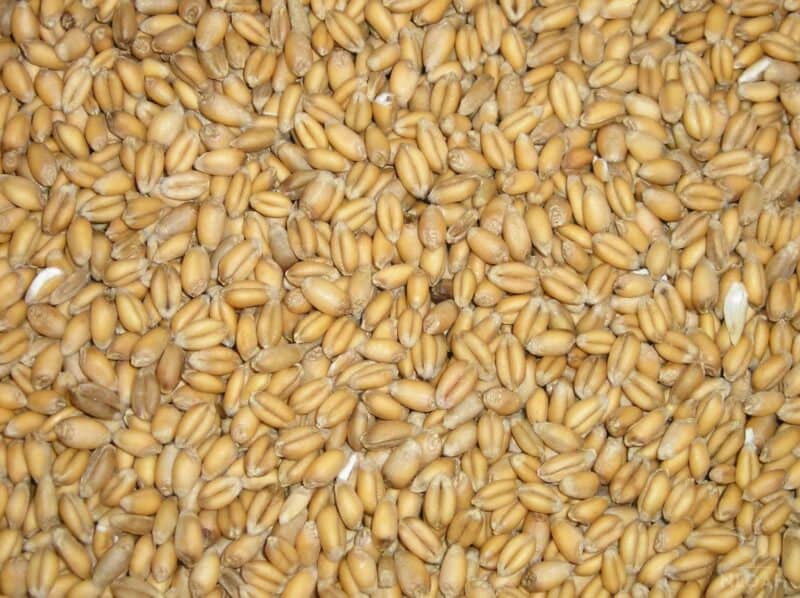
Cool, huh? This is what is ground to make flour:
I don’t know if all wheat looks the same, but this is soft white winter wheat. There are other kinds of wheat, like hard red winter wheat. Each is good for a particular kind of baking.
The soft white winter wheat is a pastry wheat, good for biscuits, pancakes, quick breads… stuff like that. It isn’t good for baking regular loaves of bread though. I’d really like to get some hard wheat for loaves, but it’s a bit more expensive since it isn’t grown locally.
Speaking of which, I love that the wheat I’m buying at the mill is locally grown!
Polyethylene or Plastic Bags
When it comes to storage, polyethylene or plastic bags are ideal. They keep out moisture and pests, and they can be resealed if necessary. Be sure to label the bags with the date of storage, and use them within six to twelve months for best results.
Other Air-Tight Containers
Beyond plastic, polyethylene, or Mylar bags, the best airtight containers for wheat berries are made of glass or metal, and have a tight-fitting lid that creates a seal. jars with screw-on lids are a good option, or you can purchase airtight storage containers specifically designed for food storage.
No matter what type of container you use, be sure to label it clearly so you know what’s inside. A
Use a Vacuum Sealer
Vacuum sealers are an excellent way to store wheat berries. By removing the air from the storage container, you can prevent the growth of mold and bacteria.
Vacuum sealed wheat berries will also stay fresh for a longer period of time. If you are planning to store wheat berries for more than a few weeks, consider using a vacuum sealer.
Other Tips for Storing Wheat Berries
There are a few other things to keep in mind when storing wheat berries.
Make Sure the Berries Are Totally Dry
If you want your wheat berries to last, it’s important to make sure they are completely dry before storing them. The best way to do this is to spread the berries out on a baking sheet and place them in a warm oven for a few hours.
Once they are dry, you can store them in an airtight container in a cool, dark place. With proper care, wheat berries can last for several months.
Find the Right Location
When it comes to storing wheat berries, the location is just as important as the container. Wheat berries should be stored in a cool, dry place, away from direct sunlight. An attic or basement can be a good option, as long as the temperature remains relatively consistent. A dry, dark pantry would work as well.
If you have other dry foods you’re storing in bulk, like bran, pasta, oats, germ, white flour, rye, or even white rice, consider keeping them all in the same general area. That way, you can monitor the condition and moisture level a bit more easily.
Check the Berries Often
One of the most important things to remember when storing wheat berries is to check them often for signs of spoilage. Look for mold, discoloration, or an off odor. If any of these signs are present, discard the affected berries immediately.
Make Sure Your Container is Airtight to Prevent Rodents
When storing wheat berries, it’s important to make sure that your container is airtight to prevent rodents from getting in and contaminating your food. Rodents are attracted to the smell of wheat berries, and they can cause a lot of damage if they get into your food storage.
While plastic bags are great for storing wheat berries in most cases, if you’re concerned about rodents, a better airtight container solution might be glass jars.
Keep Pests Out With Oxygen Absorbers
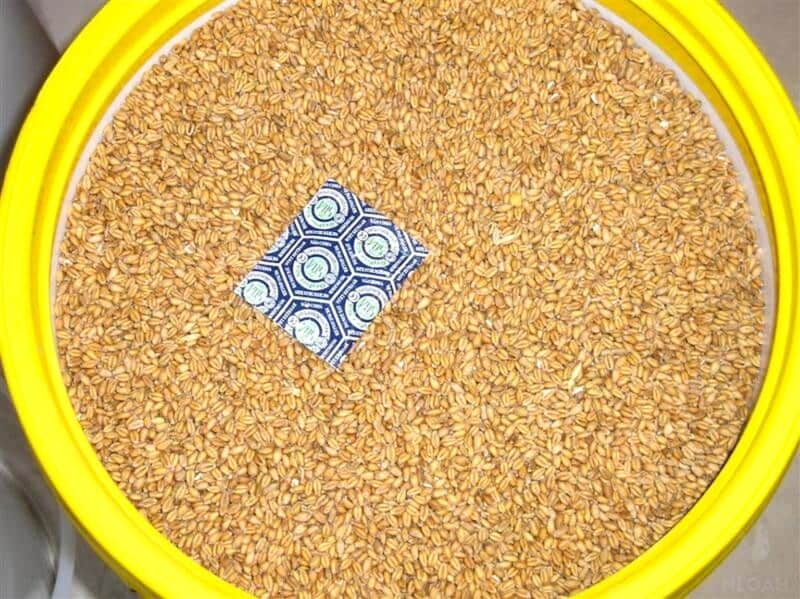
Another thing you’ll need when storing food long term is something to keep the bugs from infesting your stash. We’re using these oxygen absorbers. They come in a vacuumed bag like this.
The pink little tablet you can see in the picture tells you that the packs have not been exposed to the air. Once you open that vacuum sealed pack the oxygen absorbers will begin working, and the pill will start turning dark.
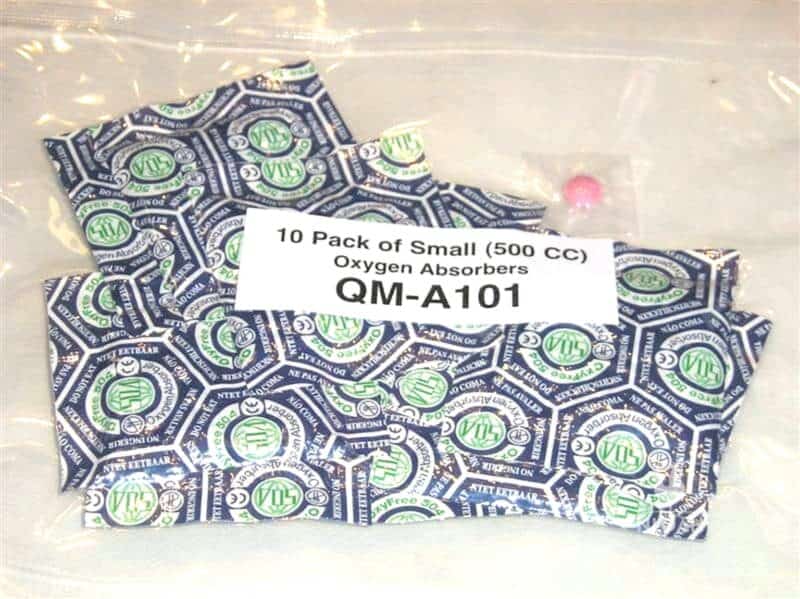
The purpose of these little packets is to absorb all of the oxygen from your bucket, making it impossible for any little critters to hatch or survive in your food. You have around 15 – 30 min.
To get the packets into your bucket and seal the bucket before they are finished absorbing their capacity and are rendered useless.
The amount of oxygen absorbers you need depends on the size of your buckets. For 6 gallon buckets it is recommended that you use approx. 2000cc’s of oxygen absorbers. Since we bought packs of ten 500cc absorbers, we used 3-4 absorbers per 6 gallon bucket.
I like to put some packs in the bottom of the bucket, and some on top before screwing the lid on. You don’t need to open the packs or anything, just drop them in. But remember to get the buckets sealed pretty quickly!
*TIP: If you have some unused oxygen absorber packets leftover, you can store them in a small mason jar, with a tightly screwed on lid. The packs will absorb a little oxygen, but will still have some absorbing ability as long as you keep them in an airtight container until ready to use.
Final Thoughts
With proper storage, wheat berries can last for months or even years, making them a valuable staple for any home cook.
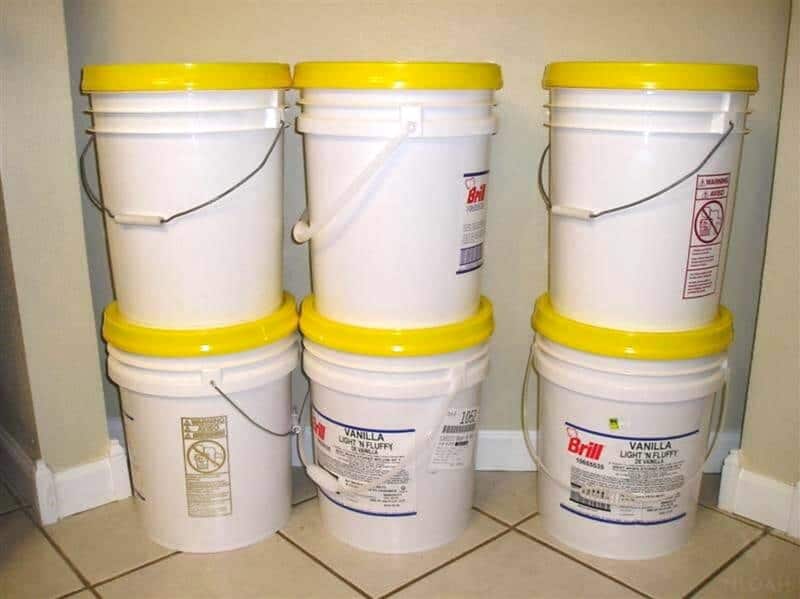
Here’s my first batch of stored wheat. It took six 6-gallon buckets filled to the rim to store 200 lbs. of wheat berries:
I did, however, leave out a little bit to grind into flour, which I’ve never done before. But that, my friends, will have to be another post!
Got any questions or tips? I’d love to hear what you think!

A city girl learning to homestead on an acre of land in the country. Wife and homeschooling mother of four. Enjoying life, and everything that has to do with self sufficient living.
Home Depot does sell food grade buckets and screw on lids, also food grade.
Do the 5 gallon buckets have to have a screw on lid? thanks
Hi,
I have winter red hard wheat berries I have purchased in bulk and I am trying to take the precautions to kill any bugs that might be in it. I have heard about freezing method, the dry ice method, and heating the berries to 150°F for 2 hours will also kill any potential bug not seen. I am curious if any of these processes will inhibit the wheat berries from sprouting and being grown in the future? I really want to be able to both grow them and make flour out of them. Thanks.
I’ve had hard wheat berries stored in Mylar, deoxygenated and in super plastic bucket with gamma lid. I bought it this way from a survivalist place probably 8 years ago. The problem, is that the last 3 years, I stored it on my porch outside, which during summers probably reached 90-100 degrees. I hope we it Today and it was clean as a whistle with no foul smell. I think its good! Is there a way to tell if it is not?
If it was bad it would probably taste bad, I would think.
Hi there!
Sorry if this is a dumb question, but if wheat berries last for decades if dry (like in the 20ib bag they came in). Why would I need to store them in a different container? Thanks!
Blessings
Hi Tammy. Great question. Wheat berries naturally will have bug eggs in them (usually weevils). If you don’t store them in a sealed container with an oxygen absorber eventually the eggs will hatch and your wheat will be crawling with bugs. (read about my weevil infestation, lol! https://www.newlifeonahomestead.com/how-to-get-rid-of-weevils/)
I’ve been told that using oxygen absorbers in a plastic bucket will create a vacuum that will crush the bucket. Is that true? I was told to use desiccant pouches inside the buckets instead.
Oh yeah, put a board between the buckets and you have shelves. Win win.
Get cleaned non treated grain. Don’t use left over seed wheat if it was treated. Put dry ice bottom and 1/2 full in your 5 gal buckets and put the lid on lightly. After the dry ice vaporized into co2…couple hours, I tapped the lid down tight. Temperature differences would cause any bad seal to leak in or out so I put some wide stretchy tape around the lid also. Diamotaceous earth would be an extra layer of protection. 10 percent or lower moisture wheat is pretty safe. Elevators can test moisture levels, or grain producers probably can test it. If this isn’t enough to suit you then you are probably obsessive compulsive.
Wheat is a bargain survival food, but it isn’t a balanced ration, but you will not starve to death during an emergency. Throw a bottle of vitamins in the bucket, and something green like dry peas. Think of this as ultra cheap insurance that you won’t starve to death. Buckets $6 each, wheat $3 to $10 per 60 pounds, dry ice cheap. You would be crazy not to do this. Depend on yourself, not the government. They represent themselves not you. If things get this bad…better have a bucket with bullets and a pistol. Societies have collapsed since forever. The US dollar is run by people that don’t know what they are doing. 20 trillion in debt… remember 2007..they finaly admitted that we were close to disaster. It’s everyman/woman for himself. Better have some properly sealed garden seeds too.
How can you tell if the wheat berries are still good? I have had mine in buckets for several years in the closet, actually around 5 years.
As long as they have stayed dry they should be fine! Wheat berries will last for a really, really long time. DECADES.
My wife bought a lot of food storage 50 years ago. The brand is called Sam Andy, the red wheat, etc came in #10 cans. Last year I opened a can of red wheat (Sam Andy) and sprouted it along side of some organic red wheat I bought 20 years ago (from a farm). They both sprouted and taste the same. No difference in sprout time. I have red wheat I bought 35 years ago and it was not stored properly. I lost 600ibs because mice really love wheat. The family wasn’t interested in sharing wheat with mice. I got rid of mice and wheat.
So does the D.E. work because I want to be able to sprout the wheat berries later has anyone tried this successfully? I know it is supposed to kill bugs so I don’t see why not?
Hello! I wwas recently given two, five gallon buckets or wheat. One is hard red and the other is white. They came strait fro the farmer and were left over from planting season. My question is how do i clean them before sealing them up for long term storage? I can not seem to find any information on this. I would appreciate and help you could give me. Thank you, 🙂
Laurie,
If the grains are already off of the stalks, and are just the wheat berries with nothing else mixed in, you don’t need to do anything before you store them. If it was me, I’d probably rinse and dry them right before grinding, but not before storage. Hope that helps!
Not sure if you got an answer about what makes up dry ice, but dry ice is completely CO2 gas…frozen…if you put it in the bucket, it will chase all the oxygen out….but of course the bucket can’t be airtight, or else the expansion of the dry ice would cause it to blow up…
Thanks Kendra! No need to be sorry – I just want to make sure they are done right!
Question- When you use the oxygen absorber in the mylar bags do they shrink up like they are vacuum sealed? I have one bag out of 8 that looks a bit more “sucked in” and the others still look “air-y.” I”m wondering if my oxygen absorbers are bad, even though they came out of a sealed bag. Either that or my seals aren’t good (using an impact heat sealer).
Katie,
Yes, the bags ought to shrink up like being vacuum sealed. Most likely it wasn’t defective O2 absorbers, but the seal probably had a leak. If there is even a pin sized hole in the seal, air will be able to get in. Sounds like you’ll need to seal them with new oxygen absorbers. Sorry about that!
The bags don’t necessarily shrink…remember, the O2 absorbers are for oxygen. The puffiness in the bag is most likely nitrogen but the oxygen has been removed. I have several bags that shrink tight and several that don’t. I’ve used some flour that is about 4 years old (puffy bag) and it was just fine. IMOO
In response to placing plastic storage containers on cement floors I do know that gasoline absorbs moister through the plastic container when kept on a garage floor – go figure. I have a question regarding a source of wheat berries. A local garden seed store has 1 – 50 lb bag of untreated red winter wheat berries for 20 bucks. Are they suitable for milling?
Robert
Very late here, myth busting, has in a container on the floor does not absorb moisture vs off floor.
Hi Kendra,
I just came across your blog and love it!
I know I’m late in chiming in, but I think I can give an answer about the dry ice. Dry ice is just carbon dioxide (same as what we exhale) that has been cooled to the point that it freezes). When you put it in the bucket it warms up and turns into gas CO2. In doing so, it fills the air spaces of the bucket, pushing oxygen out.
How long can you store Hard Red Winter Wheat Berries if stored properly?
Thanks for the oxygen tips!! Another tip is to store the buckets on wood, if you’re storing them on a cement foundation. The moisture can absorb into these 5 gallon food grade buckets. Hard to beleive, isn’t it?
Carrie,
They are still finding wheat in ancient Egyptian caves that is still good! As long as it’s stored properly, it should stay good indefinitely. At least, it won’t spoil in your lifetime!
I bought 5 lbs of Red and it is in its sealed bag is it still go – kept in dry cool basement on a wire rack shelve?
Mike
My friend puts dry ice in her bucket of grain. She says it prevents bugs and preserves. I suppose dry ice uses all the oxygen. Have you heard of this?
Annette,
Yes, I’ve heard of people doing this. I haven’t looked into it myself though. I prefer the oxygen absorbers. I don’t know exactly what dry ice is made up of.
Co2
Great post, I got a whisper meal from a friend, and I’m ordering from Something Better thru a friend. A friend of mine stores her in mylar bags with the oxygen thing. Is this oxygen packet you’re using a must? or the gamma lids a must. Could you use one or the other? Do you order just hard white wheat or soft white wheat too? I bought 50 pounds, so I would need three buckets? is that right based on your pic?
Jackie,
The oxygen packets are definitely a must if you aren’t going to be using Diatomaceous Earth. I’m going to buy some mylar bags too, as I’m beginning to feel that it’s better to have them than not. The gamma lids are a luxury… you do not need them. You do, however, need to make sure that you have a rubber gasket on the lid for the bucket. Plastic on plastic will not work. Two 5 or 6 gallon buckets should be big enough for 50 lbs of wheat. I’ve ordered hard and soft wheat. The advantage of soft white wheat is that it’s generally cheaper and can be used for breads which don’t require yeast. You can use hard white wheat for any recipe though, it’s just a little more expensive. I buy both to save money. 🙂
I was told to put a couple of bay leaves with the berries to keep the bugs away. I don’t know if it works yet since I am needing to buy another sack of wheat, but my last bucket, (gallon size), from my last batch did have bugs in it. I fed it to my chickens.
Kendra, Have you tried to grow your own wheat yet?
Rene,
Nope. Not sure we have the room to grow wheat… maybe a little. But I’d love to be able to do that!!
I have a question, do you know of any kind of good wood stove that I could use for cooking and baking like the bread in case of an emergency? Thank you.
Siana,
Are you looking for a regular heating wood stove, or a wood cook stove?
I’ve had a grain mill for 4 & 1/2 yrs now. I’m about to get started with long term storage by putting grain into mylar bags w/oxygen absorber and sealing the bags. My concern is the grain, that I have which maybe a few years old, if I don’t see any bugs…do I still go ahead, seal & store OR do I need to store buckets in the garage (temp. in the teens here, winter time) before sealing them?
I had a 50 lb bag of millet, about 1/2 gone when I discovered tiny tiny little bug (smaller than grease ant, tan in color? almost clear) one way I detected ‘if’ there was any in the 2nd small container was to run my hand through it and then pulled my hand up…and I could see them on my hand 🙁 When I 1st got the grain, I put them into small containers…some were big plastic deli containers (maybe held 5 or 10 lbs). I don’t know if the containers sealed well, I think bugs may have gotten into it, not sure. 1 small glass container was fine.
I have not yet checked the rest of our grain buckets to see if the rest of the grains are safe. If I store grain in a mylar bag, would the oxygen absorber take care of any possible bugs in the grain? Any additional suggestions, would be appreciated. Thank You!
Priscilla,
If the older grain doesn’t have any bugs in it, yes, definitely go ahead and seal and store using the mylar bags and oxygen absorbers. They oxygen absorbers will make it impossible for any eggs to hatch in your wheat. Make sure you have them sealed well though. And don’t store the buckets in a garage long term, where they will be exposed to heat/cold/heat/cold. The condensation will build up inside the buckets and spoil the wheat.
Hi
I noticed you were stacking your buckets with gamma seal lids. I actually called and asked the company if I could do that. They recommended that I did not but put a board over the top of the buckets before adding some on top. They say the lids are not intended to bear weight.
Great tips and Blog – thanks!
Yvonne,
Thanks for letting me know! It hadn’t even occurred to me that I might not stack them!
We just did our long term food storage. We got a variety of rice and grains. We put the grains in mylar bags, and then into a bucket, mixed in food grade d. earth, put in oxygen absorbers, ironed a portion of the bag closed and sucked out the air with our vacuum, then ironed it the rest of the way closed. I didnt do any research first, just listened to some friends of ours who did the same thing, after they did their own research. Maybe it was overkill, but i guess at least its really protected from the elements. Im planning to do what you did for short term stuff that I’ll be grinding.
Hi all. Just wanted to share that 10 years ago I stored wheat berries (don’t remember what kind). I’ve got them in a plastic bag inside those tight lid plastic containers. Last month I got curious to see what the wheat looked like and opened one. To my surprise the berries had broken down and turned into flour in the middle of the container. Now I’m not sure what to do. Is it still good? Should I start over? I didn’t see any evidence of any bugs. I didn’t use any any oxygen packs or that organic earth people are talking about. Does anyone know if any harmful chemistry occurs when the wheat breaks down like that? MUCH thanks.
A lot to do about storing the wheat! Myself, I just store it in a paper bag, nothing to it, just in the basement. As long as your wheat stays dry, you shouldn’t have any problem. As for bugs and vermin, I only think you should worry a lot about mice and rats. Bugs won’t eat the whole berries when it is dry. They have found wheat in the Egyptian pyramids that was perfectly edible! (Once ground it does get bad quite quickly, and bugs might become a problem then).
What kind of mill do you use? I have a small hand-mill, it takes me 20 minutes to grind 1lb. flour. I read that your first intend was to buy 500lbs. That’s a lot! What are you going to use the wheat for? Just for baking? Myself, my wife and our 2,5 year daughter (the 1-year old doesn’t eat a lot of bread…) eat about three breads a week, that’s 3lbs. of flour. I think, if you bake all your bread from your own wheat, your 200lbs supply should last for about a year.
I’ve bought my wheat (just 30lbsto start with) at a local wholesaler’s, since I was to late to buy it from a local farmer (they sell their harvest almost entirely very soon after they got it off the field). I arranged with him that he would tell me when he is going to harvest this year, and I’ll buy my supply directl from him. That might also be a good idea for all the people here looking for a large amount of wheat (or any other produce). Get to know any local farmers!
Good luck grinding and baking!
I am just starting this also! I am ordering with a Mormon church in my area and we are ordering from Montana Wheat. There has to be a 5000 lb min. in order for them to send a truck out and deliver it. I got a sample of the ground wheat today and some wheat berries. So excited to try making some bread. it is the red winter wheat. I am also buying some other wheat berries to mix in because I hear it makes the bread better.
I think that is why I love your blog so much – because we are learning together! LOL
I’ve been having a wheat grinder for a while. Already bought 3 gamma lids, a pack of 10 oxygen obsorbers and got 4 (I think) food grade buckets and lids from the local bakery. I have a couple #10 cans of wheat I bought to try out but haven’t done so yet. As soon as budget allows, I’m going to be making a large bulk purchase of wheat myself and packaging it too.
A tip for readers who are short on storage space… I was searching around our small, 2 bed room mobile home for yet another “stash spot” for the buckets once I have them filled and need to store. Well, came up with a great idea to put them behind our sectional couch! I pulled them up some, put the empty buckets behind them to see how it looked and you can’t tell! It’s great because it’s out of the way, making use of dead space (they have to be pulled out some anyway for the recliners to work) and it’s not obvious to visitors.
I’ve also read about people putting them under their bed. I’m sure that would make ours a littel too tall considering we have low ceilings to start with. But it’s an idea…
juju_mommy,
Great storage ideas! Addy also lives in a single wide, and they have their beds built up to allow buckets for storage underneath them. I believe they are smaller buckets though, not the 5-6 gallon ones. She also had her husband build shelves where her dryer used to be in the laundry area. Shelves in closets make great use of dead space. One could also make a skirt of fabric to go around the bottom of a table to hide stuff under there too.
Enjoyed your post, especially since we are about to buy wheat berries in quantity to store and were also just researching buckets online the other night. We came up with the same info that you posted about the buckets. One thing we also read was that if you want to be able to possibly sprout any of the berries later (which we might, if we are ever in a situation where we need to plant and grow more wheat for ourselves), the oxygen packets apparently do something to the berries so they won’t be able to sprout. So in our case, we are going to go with using the food grade diatomaceous earth. We’ve read a lot about it, and for us, it sounds like the way to go. So if you guys might want to have some berries on hand for possible future planting, you may also want to consider storing at least some with the d. earth next time you buy berries. By the way, you had mentioned that the man at the mill said he got his from the pool supply store–I read online that you should only get the kind that is food grade (which isn’t very expensive) and never from the pool store because it might have toxins or something like that. Apparently the guy is still alive after all these years, though, ha ha! Well, wow, it’s nice learning from each other about these things, and it was interesting to see how many buckets it takes to hold 200 pounds of berries. 🙂
Pam-
Glad it was helpful! Thanks for the sprouting tip. I hadn’t heard that about the oxygen absorbers. Looks like we’ll need to get some (food grade) D.E. too!
That’s totally cool. Do you know how long that will last your family if there were no grocery stores?
Sarah B
I think this would last about 5-6 months.
Looks great! 🙂 You can also get hard white wheat for bread which I like better than the hard red. It makes a little lighter colored and not so “heavy” loaf of bread. So when you do get the hard wheat, you might try some white and some red and see what you like before you buy a bunch of either.